
Identity area
Reference code
Title
Date(s)
- n.d. (Creation)
Level of description
Sub-item
Extent and medium
1 lantern slide - Standard format (3 1/4 x 3 1/4 inch square)
Context area
Name of creator
Biographical history
John Watt Beattie (1859-1930), photographer and antiquarian, was born on 15 August 1859 at Aberdeen, Scotland, son of John Beattie, master house-painter and photographer, and his wife Esther Imlay, née Gillivray. After a grammar-school education he migrated with his parents and brother in 1878, and struggled to clear a farm in the Derwent Valley, Tasmania. He soon turned to his life's work. From 1879 he made many photographic expeditions into the bush, becoming a full-time professional in 1882 in partnership with Anson Bros whom he bought out in 1891. Gifted with both physical zeal and craftsman skills, he probably did more than anyone to shape the accepted visual image of Tasmania. An admirer of William Piguenit, Beattie stressed the same wildly romantic aspects of the island's beauty. His work included framed prints, postcards, lantern-slides and albums, and was the basis for a popular and pleasing set of Tasmanian pictorial stamps (in print 1899-1912).
Many of Beattie's photographs of people and places were published in the Cyclopedia of Tasmania, (1st edn. 1900). He also prepared sets of lecture slides on the topography and history of Tasmania and gave many lectures himself. He was interested in the history and made an important collection of items relating to Port Arthur &convict days, which was sold to the Queen Victoria Museum, Launceston in 1927. Another collection was secured for the Tasmanian Museum Hobart after Beattie's death through William Walker, the City paying £250. Some of Beattie's lectures and photographic notes were placed with the Royal Society's manuscripts on loan by the Museum. Some other papers of J.W. Beattie were bequeathed by him to the Royal Society for safe-keeping. These consist of copies of historical manuscripts and some original manuscripts, press cuttings and notes.
For more information see: http://adb.anu.edu.au/biography/beattie-john-watt-5171
Name of creator
Biographical history
Sir Thomas Gore Browne (1807-1887), colonial governor and soldier, was born on 3 July 1807 at Aylesbury, England, son of Robert Browne of Morton House, Buckinghamshire, and his wife Sarah Dorothea, née Steward. His brother, Edward Harold, became bishop of Winchester and Ely. On 10 December 1861 Browne was appointed governor of Tasmania. His predecessors had represented the 'old order'; as the first governor appointed after the colony had achieved responsible government he was warmly welcomed in Hobart with a carnival which lasted a week. for more information see: http://adb.anu.edu.au/biography/browne-sir-thomas-gore-3086
Immediate source of acquisition or transfer
Content and structure area
Scope and content
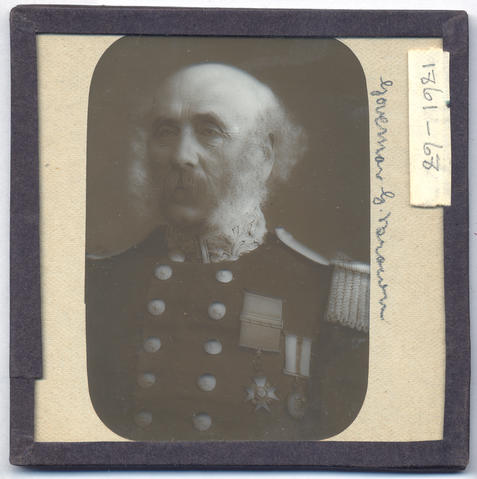
Lantern slide of Governor Sir Thomas Gore Browne. Governor of Tasmania from 1861-1868. Prepared by J.W. Beattie (1859-1930) whose studio locations were Elizabeth Street, Hobart from 1891-1920, Murray Street from 1921-40 and Cat and Fiddle until 1994.
Appraisal, destruction and scheduling
Accruals
System of arrangement
Conditions of access and use area
Conditions governing access
Conditions governing reproduction
Language of material
Script of material
Language and script notes
Physical characteristics and technical requirements
Finding aids
Existence and location of originals
Existence and location of copies
Related units of description
Publication note
Allport Library and Museum of Fine Arts, Tasmanian Archive and Heritage Office - https://stors.tas.gov.au/AUTAS001142928092
Alternative identifier(s)
Access points
Subject access points
Place access points
Name access points
Genre access points
Description identifier
Institution identifier
Rules and/or conventions used
Status
Level of detail
Dates of creation revision deletion
Language(s)
Script(s)
Sources
Digital object metadata
Latitude
Longitude
Media type
Image
Mime-type
image/jpeg